
BITCOIN, EXPLAINED IN SMALLER PARTS
Bitcoin Halving: What Changes, and When?
The Bitcoin halving cuts the new Bitcoin issued per block in half. It happens every 210,000 blocks, roughly every four years. It changes issuance, not the number of bitcoins already in your wallet.
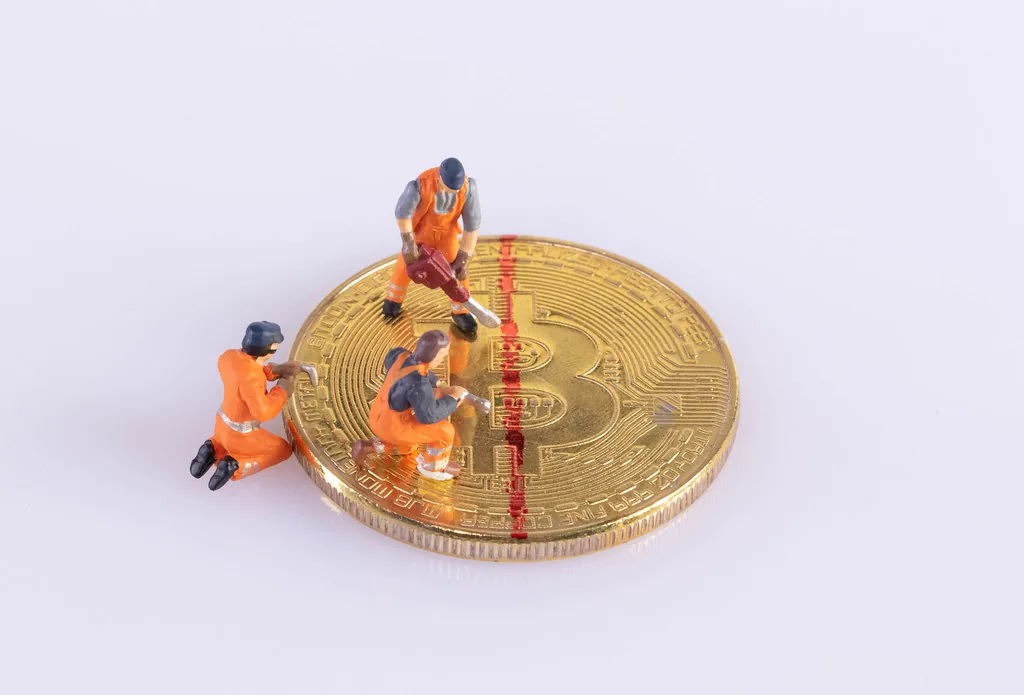
Bitcoin halving reduces new BTC issued per block by 50% every 210,000 blocks, roughly every four years. The 2024 halving cut the subsidy from 6.25 to 3.125 BTC; existing holdings stay unchanged.
Photo: Miniature workers cutting Bitcoin. Halving concept by Marco Verch, CC BY 2.0. Compressed and converted to WebP.
What is Bitcoin halving?
Miners can receive newly issued Bitcoin, called the block subsidy, when they produce a valid block. Bitcoin’s rules reduce that subsidy at scheduled block heights. “Halvening” is another name for the same event.
The subsidy began at 50 BTC per block. Successive halvings reduce the rate at which new coins are created. Existing coins are not removed or divided by the event.
Sources: Bitcoin Core: block-subsidy calculation. Checked October 22, 2026.
Why does Bitcoin halving happen?
Bitcoin halving happens to reduce the rate at which new bitcoins are created and keep issuance within the protocol’s supply limit of approximately 21 million BTC. Every 210,000 blocks, the permitted block subsidy falls by half. This makes Bitcoin’s issuance schedule predictable without requiring a central authority to decide how many new coins to release.
New bitcoins enter circulation through mining. The subsidy gives miners an incentive to commit computing power to producing valid blocks and distributes coins without a central issuer. Successive halvings gradually reduce that source of miner income; transaction fees can also compensate miners.
How halving limits Bitcoin supply
The initial subsidy was 50 BTC per block. It then fell to 25, 12.5, 6.25 and 3.125 BTC. Each subsidy level applies for 210,000 blocks. Adding these progressively smaller amounts produces a total approaching 21 million BTC; whole-satoshi rounding makes the maximum scheduled issuance slightly lower.
Halving therefore reduces supply growth. It does not cut the existing supply in half, remove coins from wallets or automatically make Bitcoin more valuable. The ten-minute target for average block production makes 210,000 blocks roughly four years, rather than an exact calendar interval.
Sources: Bitcoin Core: subsidy calculation and block validation · Bitcoin white paper, section 6: incentives · Bitcoin.org: halving schedule. Checked October 23, 2026.
The latest halving happened in April 2024
As of October 22, 2026: the latest halving occurred on April 20, 2024 (UTC), at block 840,000. The subsidy fell from 6.25 BTC to 3.125 BTC per block.
This subsidy remains in effect until the next scheduled halving.
Sources: Bitcoin.org halving schedule. Checked October 22, 2026.
When is the next Bitcoin halving?
The next scheduled halving is at block 1,050,000, expected around 2028. It will reduce the subsidy from 3.125 BTC to 1.5625 BTC.
The block height is fixed by the schedule; the calendar date is an estimate. Blocks do not arrive at perfectly regular intervals, so a countdown can change as new blocks are mined.
Sources: Bitcoin.org halving schedule. Checked October 22, 2026.
Bitcoin halving history
| Event date (UTC) | Block height | New subsidy |
|---|---|---|
| November 28, 2012 | 210,000 | 25 BTC |
| July 9, 2016 | 420,000 | 12.5 BTC |
| May 11, 2020 | 630,000 | 6.25 BTC |
| April 20, 2024 | 840,000 | 3.125 BTC |
| Around 2028 (estimate) | 1,050,000 | 1.5625 BTC |
Sources: Bitcoin.org halving schedule. Checked October 22, 2026.
Will Bitcoin halving increase price?
Bitcoin halving can support a higher price by reducing new issuance, but it does not guarantee a price increase. The bullish argument is that fewer newly mined coins may be offered for sale while demand remains steady or grows. The actual price also depends on demand, existing holders’ selling and market expectations.
What changes on the supply side?
At an illustrative 144 blocks per day, the 2024 subsidy change reduced potential new issuance from about 900 BTC to 450 BTC per day. The next halving would reduce that figure to about 225 BTC per day at the same block rate. These are schedule-based estimates, not a measurement of coins sold: miners can hold their rewards, and actual daily block counts vary.
Why can Bitcoin’s price fall after a halving?
Existing owners can still sell their coins, and demand can weaken enough to outweigh the reduction in new issuance. Because the halving schedule is public, traders may anticipate its effects before the event. A halving does not create a new buyer or specify the price at which anyone must trade.
Research by CME Group documents substantial gains after the 2012, 2016 and 2020 halvings, while also questioning whether later cycles would repeat them. Those observations show an association, rather than proof that halving alone caused the gains. A small number of past events cannot establish a dependable return or waiting period.
There is no automatic doubling rule. A 50% reduction in new issuance does not imply a 100% increase in price. Neither a target price nor a fixed number of days to a rally can be calculated from the halving rule.
Sources: Bitcoin.org: supply, demand and price · CME Group: historical returns and their limits · Blockstream: issuance and price context. Checked October 23, 2026.
Who controls Bitcoin halving?
No individual, company, government or mining pool controls Bitcoin halving. The schedule is part of Bitcoin’s consensus rules: the rules that full nodes independently apply when deciding whether a block is valid. A halving takes effect at its specified block height without a fresh vote, announcement or software release.
Satoshi Nakamoto included the declining issuance schedule in Bitcoin’s original design. Today, the roles are distributed:
- Miners produce blocks. They can claim the permitted subsidy and the transaction fees in each valid block.
- Full nodes verify blocks. A node enforcing the existing rules rejects a block that claims more than the permitted subsidy plus fees.
- Developers propose software changes. Publishing new code does not oblige people to run it.
- Users and businesses choose what to accept. Their software choices and economic activity matter to the adoption of any proposed rule change.
This is not a simple vote in which owning more BTC, running more nodes or controlling more mining power gives someone authority to rewrite issuance. The practical constraint is whether other participants accept the changed rules. The implications of changing the schedule are explained below.
Sources: Bitcoin.org: control of the network · Bitcoin Core: subsidy calculation and block validation · Bitcoin developer guide: consensus rule changes. Checked October 23, 2026.
When will Bitcoin halving end?
Bitcoin’s subsidy reductions are expected to end around 2140, when the 33rd halving reduces the subsidy to zero at block 6,930,000. Under the current rules, block 6,929,999 is the final block eligible for a positive subsidy. The block height is defined by the protocol; the calendar year remains an estimate.
Why does the subsidy eventually reach zero?
Bitcoin records on-chain amounts in whole satoshis, with 100,000,000 satoshis in one BTC. Its subsidy calculation discards fractions of a satoshi. At block 6,720,000, the 32nd halving leaves a subsidy of one satoshi per block. At the next halving, half a satoshi rounds down to zero.
| Block height | Approximate year | Subsidy per block |
|---|---|---|
| 6,720,000–6,929,999 | Around 2136–2140 | 1 satoshi (0.00000001 BTC) |
| 6,930,000 onwards | Around 2140 onwards | 0 BTC |
Sources: Bitcoin developer reference: subsidy and block reward · Bitcoin Core: subsidy calculation and block validation. Checked October 23, 2026.
What happens to miners after the last Bitcoin is mined?
Ending new issuance does not switch off Bitcoin or prevent further blocks. Miners can continue earning transaction fees paid in existing BTC. The white paper describes this transition to fee-funded incentives. Whether future fee revenue supports sufficient mining security depends on future usage and mining economics; it is not a guaranteed outcome.
The 21 million figure describes the supply ceiling, not a promise that all those coins will be spendable. Rounding, unclaimed subsidies and inaccessible coins mean scheduled issuance, actual issuance and accessible supply are different measures. Learn more about satoshis and Bitcoin’s smallest on-chain unit.
Sources: Bitcoin white paper, section 6: incentives · Blockstream: final issuance and the transition to fees. Checked October 23, 2026.
Can Bitcoin halving be stopped?
Bitcoin halving cannot be cancelled or postponed by a decision from a miner, developer, exchange or government under the existing rules. It occurs automatically when the chain reaches each scheduled block height. Removing future halvings while continuing to issue a higher subsidy would require a change to the consensus rules.
Could a hard fork remove the halving?
Software can be changed, but getting a network to accept different monetary rules is a separate challenge. Allowing a subsidy above the existing limit would require a hard fork: blocks permitted by the new rules would be invalid to nodes enforcing the original schedule. Participants could refuse the change and continue following the existing rules.
Broad adoption would be needed for a changed schedule to become accepted across the Bitcoin economy. There is no administrator who can order that adoption, and disagreement could leave separate networks. The schedule is therefore enforceable by participants, rather than physically impossible to alter in software.
Could a 51% attack stop Bitcoin halving?
A majority of mining power does not make an excessive subsidy valid to nodes that enforce the current rules. Mining attacks can disrupt block production or transaction confirmation, but they do not by themselves change the subsidy limit.
Slower block production can delay the calendar date on which a halving height is reached. If no blocks were produced, the chain would not advance. Neither situation removes the rule: once the relevant height is reached on a chain following today’s rules, the lower subsidy applies.
Sources: Bitcoin developer guide: consensus rule changes · Bitcoin Core: subsidy calculation and block validation · Bitcoin developer guide: proof of work and valid chains. Checked October 23, 2026.
Does the whole mining reward halve?
A miner’s block revenue can include both the subsidy and transaction fees. The scheduled halving applies to the subsidy. It does not mechanically cut every transaction fee in half or fix a miner’s total income.
A lower subsidy changes mining economics. Actual revenue also depends on fees and the BTC price, while profitability depends on operating costs and competition.
Sources: Blockstream: mining, block rewards and fees. Checked October 22, 2026.
What happens to half a Bitcoin you already own?
If you hold 0.5 BTC before a halving, the event leaves you with 0.5 BTC afterwards. That amount is still 50,000,000 satoshis. Its money value can change with the market price.
For the basics, read can you buy half a Bitcoin? Use the Bitcoin and satoshi calculator to explore units, or the fee guide to understand purchase and transfer costs.